Overcome Your Hip Pain
Are you a CrossFit athlete or lifter in Charlottesville dealing with stubborn pain in the front of your hip? You’ve probably tried stretching your hip flexors, foam rolling, and pushing through the discomfort—but the pain keeps coming back. The good news? You’re not alone, and there’s a better solution and something that we commonly see that can respond very well to physical therapy (if correctly diagnosed and treated)
At Whole Strength Physical Therapy, we help active adults and athletes in Charlottesville get out of pain and back to training—without taking unnecessary time off from the gym. One of the most common issues we treat for front-of-hip or groin pain is Femoroacetabular Impingement (FAI)—a condition that is commonly misdiagnosed but can dramatically improve with the right physical therapy approach.
Let’s dive into what FAI is, how it shows up in lifters and CrossFit athletes, and what you can do to stay active while healing properly.
Today we will go over a common cause of groin/anterior hip pain - discussing what it is, activity modifications, and overall treatment approach that will allow you to continue being active while resolving this issue.READ: The Role of Strength Training in Managing Chronic Conditions
What is Femoral Acetabular Impingement (FAI)
There are several potential causes for pain in the front of your hip, however, Femoral Acetabular Impingement (FAI) is an issue that is more times than not the culprit. FAI is a condition where abnormal contact between the ball and socket of the hip joint limits mobility and irritates the surrounding tissues like the labrum. Symptoms are typically located in the front of the hip or groin and usually present as “pinching” or “locking/clicking”. Activities such as sitting, deep squatting, or other movements that involve end-range hip flexion (knee toward the chest) are most problematic. Additionally, motions such as pivoting and twisting are not tolerated well by most people dealing with FAI.In CrossFit athletes and lifters, it often presents as groin or front-of-hip pain during:
- Deep squats
- Olympic lifts
- Kipping or hanging movements
- Long periods of sitting or driving
Symptoms may include:
- Pinching at the front of the hip
- Clicking or locking sensations
- Loss of hip mobility or depth
- Pain with twisting or pivoting
If these sound familiar, you’re not alone. We work with many Charlottesville lifters and CrossFitters who deal with these exact symptoms—and the good news is, you don’t have to stop training.
Does this sound like you? Keep reading.
READ: Physical Therapy in Charlottesville for Strength, Mobility, and Long-Term Athletic Health
Why CrossFit Athletes can Have Hip Pain
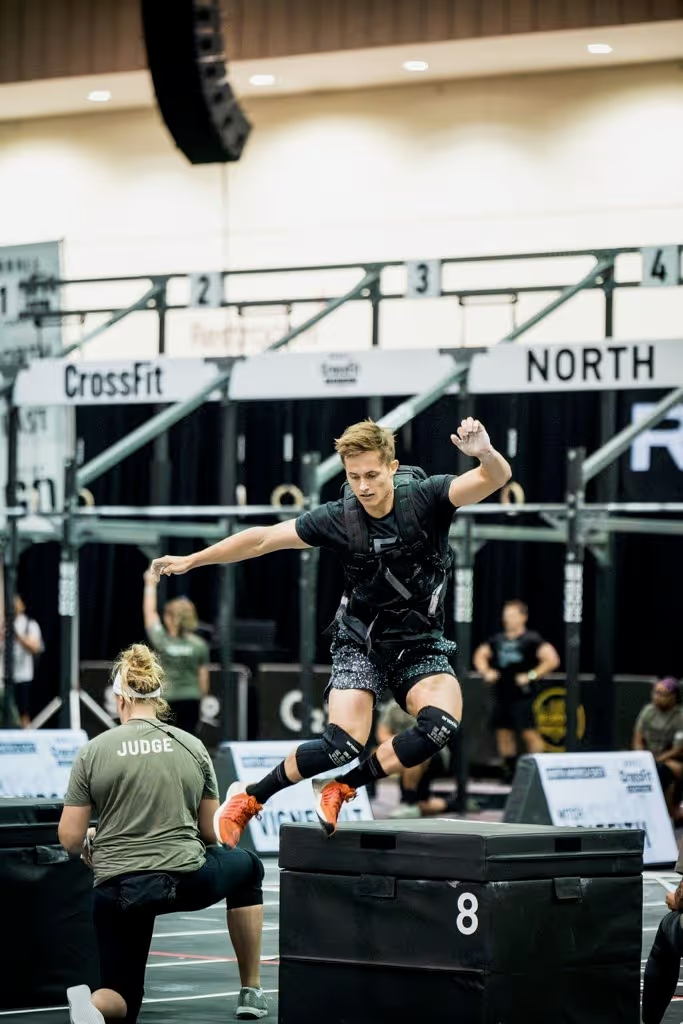
In CrossFit and weightlifting, athletes frequently train deep ranges of motion under load. Movements like squats, cleans, snatches, and box jumps all challenge the hip joint in ways that can expose or aggravate underlying impingement—especially when mobility or motor control is lacking.
Many traditional rehab models simply say, “Just stop squatting” or “Avoid deep hip flexion.” But at Whole Strength Physical Therapy in Charlottesville, we take a different approach: we teach you how to train smarter—without avoiding the movements you love.
Treatment and Smart Training Modifications for FAI
The first thing that you want to do if you are experiencing FAI symptoms is modify exercises, repetitive motions, or postures that may be upsetting the joint and increasing your pain. For example, changing how you sit at your desk or changing the seat in your car can be an excellent starting point. Instead of forcing a perfectly upright torso, try slightly leaning back to increase the angle at your hip and decrease stress at the joint. Another strategy to achieve the same result would be increasing the height of your hips in relation to your knees. This could be done by sitting on a cushion, sitting on an elevated stool, or even changing the angle of the bottom portion of your seat in the car. In addition to modifying your day-to-day life, it is also important to properly modify your training in order to continue working out without exacerbating the issue and to avoid feeling like you have to stop exercising altogether. Below we will list exercises that cover a spectrum of difficulty for the hip that you can use to progress your training and help modify your current exercise routine. The difficulty is in relation to stress that would be placed to the hip joint, not the general challenge of the exercise.
If you suspect you're dealing with FAI, don’t just keep pushing through the pain—modify your training environment and movement patterns to reduce irritation.
Here’s how:
Everyday Adjustments:
- Optimize Sitting Position: Slightly recline your seat or raise your hips relative to your knees with a cushion.
- Driving Modifications: Adjust seat angle to reduce hip compression on long drives to and from the gym.
Gym-Based Modifications:
We’ve created a progression of hip-friendly exercises for athletes in different stages of rehab or sensitivity. These exercises allow you to stay active and continue building strength while protecting the hip joint.
Low-Stress Options (Great for Deload Weeks or Flare-Ups)
Moderate Stress Options (When Symptoms Are Improving)
High-Stress Options (When You're Close to Full Return)
💡 Pro Tip: Many CrossFit athletes/lifters with FAI can better tolerate front squats than back squats because of the more upright torso, which puts less load on the hip joint.
Summary: You Don’t Need to Stop Training
Hip impingement doesn’t mean the end of your lifting or CrossFit career. In general, cutting depth in a squat or elevating the bar for a deadlift can be an appropriate modification. Additionally, movements that are front loaded (ie. front squat) vs. back loaded (ie. back squat) are typically tolerated better.
With the right modifications, you can:
✅ Reduce pain
✅ Maintain your strength
✅ Progress intelligently back to full-range lifting
This is a short list of exercises, however, hopefully this can provide you with a general sense of how to modify and progress exercises for your workouts.
Fighting through hip pain in your sport or everyday life can be frustrating and you can feel defeated. However, finding modifications that help you continue to train and implementing positional changes that improve the comfort of the hip, can be great starting points to decrease sensitivity, maintain strength, and get you moving in the right direction toward a successful recovery.
At Whole Strength Physical Therapy, we believe in building resilient athletes who don’t just recover—they come back better.
Get a Professional Assessment in Charlottesville, VA
If you’re not sure whether your hip pain is FAI or something else, don’t guess—get evaluated by a professional. We specialize in performance physical therapy for CrossFit athletes and strength-based sports here in Charlottesville. Complete rest as typically prescribed by the medical field that doesn't commonly work with strength athletes and then pushing too hard too soon is one of the most common causes of re-injury, and the cost of another setback is far greater and frustrating than taking the time to get it right the first time.
Whether you’re in a flare-up or just want reassurance that your training is aligned with long-term joint health, our one-on-one sessions will give you the answers and the plan you need.
👉 Click the button below to schedule a performance evaluation at Whole Strength Physical Therapy in Charlottesville today and take the first step toward pain-free lifting and peak performance.